
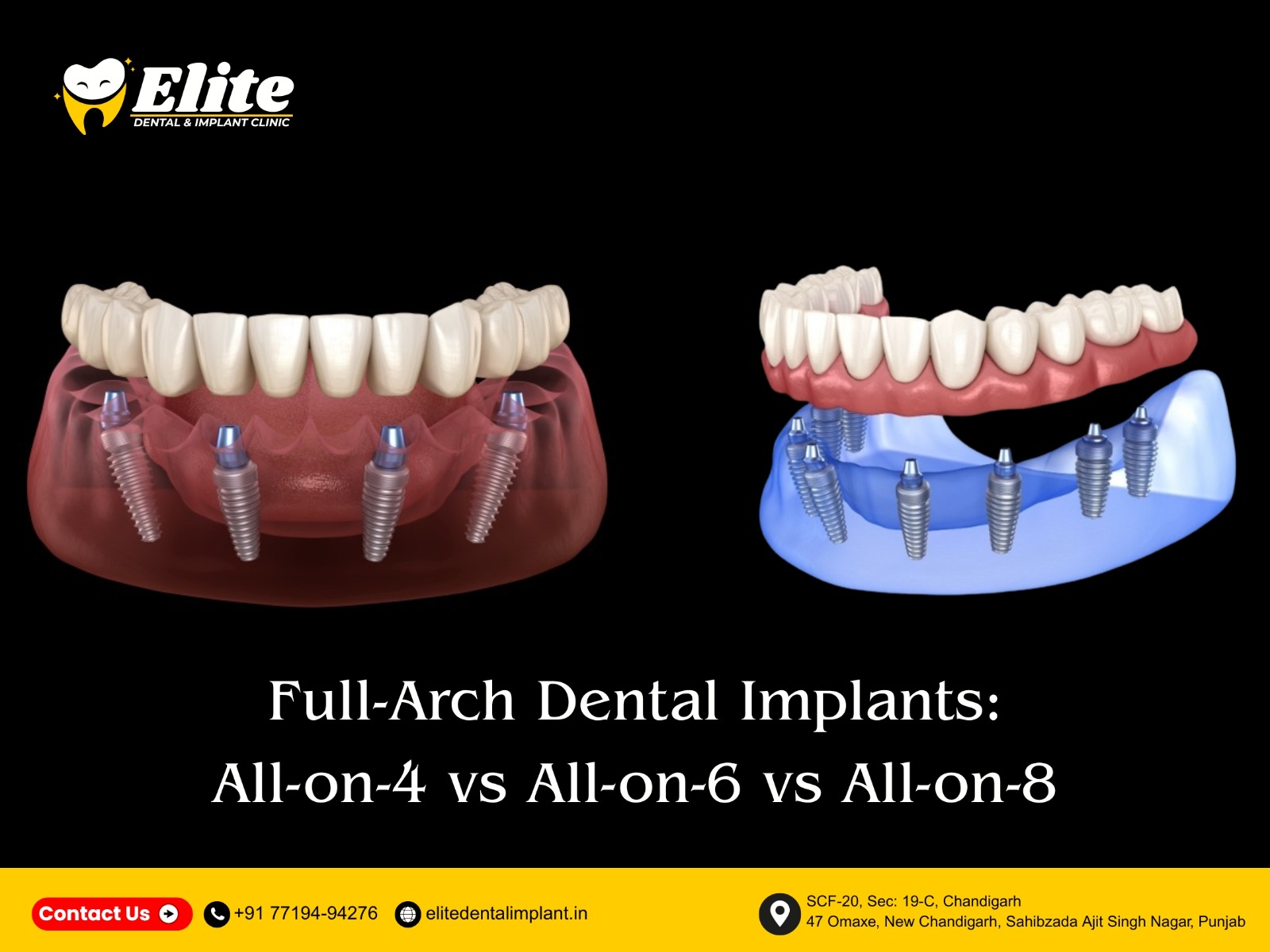
Full-Arch Dental Implants: All-on-4 vs. All-on-6 vs. All-on-8
Introduction
Losing many or all teeth in a jaw arch — upper or lower — can severely impact chewing, appearance, and quality of life. Traditional dentures are one solution, but they often slip, require adhesives, and can feel unstable. That’s where full-arch implant solutions come in, as a fixed option within the broader types of dental implants designed to replace an entire arch of missing teeth. The “All-on-X” concept allows you to get a fixed, permanent set of teeth using full-mouth dental implants — restoring a complete arch without placing one implant per tooth. This approach replaces dentures with a stable bridge, giving you the comfort and function of natural teeth again.
What Are Full-Arch (All-on-X) Implant Solutions?
• The term “All-on-X” refers to restoring an entire dental arch using full-arch dental implants supported by X number of implants (e.g. 4, 6, or 8). Instead of placing an implant for every missing tooth, a full-arch prosthesis (fixed bridge) is anchored to only a few implants.
• Key technique: The posterior (back) implants are often angled to maximise contact with the densest available bone — avoiding nerve canals or sinus cavities. This strategic angling improves stability and allows anchorage even when the bone amount is limited.
• This technique often allows immediate function: many patients receive a fixed provisional bridge on the same day as implant placement — so they leave with teeth instead of removable dentures.
Full-arch implant solutions, therefore, offer a permanent, denture-free, fixed replacement for a lost arch — with fewer implants, less complexity, and a quicker turnaround compared to traditional “one-implant–one-tooth” approaches.
All-on-4 Implants: Procedure and Benefits
What is All-on-4?
• All-on-4 dental implants use four implants per arch to support a fixed full-arch prosthesis. Typically, two implants are placed vertically in the front (anterior), and two implants are placed at an angle in the back (posterior).
• The angled posterior implants help avoid anatomical obstacles (sinus cavity in the upper jaw or nerve canal in the lower jaw) and make the best use of available bone.
Benefits of All-on-4 Dental Implants:
• Cost-efficient compared to configurations with more implants, because fewer implants and associated components are needed.
• Often avoids bone grafting, because the angled implant placement uses residual bone effectively. That’s especially advantageous for patients with moderate bone loss or who wish to avoid graft surgery.
• Faster procedure and recovery — fewer implants, simpler surgery; many patients receive a provisional (temporary) fixed prosthesis on the same day.
• Good for moderate bone conditions — if your jawbone has not severely resorbed, All-on-4 often suffices.
Ideal candidate for All-on-4:
• Patients with moderate bone loss but still enough bone in the front for implants.
• Those who prefer a faster, less expensive, and less invasive route to fixed teeth rather than removable dentures.
All-on-4 often serves as the foundation — and remains a valid, widely used technique for people seeking stable, full-arch restorations without extensive bone surgery.
All-on-6 and All-on-8 Implants: When to Consider Them
Why more implants?
As the number of implants increases — six or eight per arch — the support for the prosthetic arch becomes stronger. This improves stability, distributes chewing forces more evenly, and typically offers better long-term durability.
All-on-6 Dental Implants
• Uses six implants, often placed more evenly across the arch.
• Provides greater stability and bite force, making it better for heavy chewing, larger jaw arches, or patients with high functional demands.
• Reduces stress per implant by distributing load over more implants — improving longevity and reducing risk of prosthesis failure.
All-on-8 Dental Implants
• Involves eight implants per arch, offering maximum support and stability for the prosthetic arch.
• Often chosen for patients with strong bone volume and when maximum durability, function, and long-term success are the goal.
• Provides the best load distribution and structural integrity, especially useful when restoring a full arch for heavy chewing needs or long-term use.
When to consider All-on-6 / All-on-8:
• If you have good bone density and volume, allowing placement of extra implants.
• If you are a heavy chewer, need strong bite force, or have a long dental arch requiring more support.
• If long-term durability, minimal maintenance, and maximum comfort are priorities — and higher cost and more complex surgery are acceptable.
Comparing All-on-4, All-on-6, and All-on-8 for Full-Arch Restoration
| Feature / Factor | All-on-4 | All-on-6 | All-on-8 |
| Number of Implants | 4 per arch | 6 per arch | 8 per arch |
| Bone Density / Volume Required | Relatively lower — angled implants often avoid grafting | Moderate — needs sufficient bone for six implants | Highest — best if bone volume and density are good |
| Surgical Complexity & Invasiveness | Lower (fewer implants, less surgical time) | Medium (more implants, slightly more surgery) | Higher (most implants, more complex planning and placement) |
| Cost | Lowest (few implants) | Medium (additional implants add cost) | Highest (most implants + materials + complexity) |
| Stability / Load Distribution / Long-Term Support | Good — often enough for many patients with moderate bone | Very good — added implants improve load distribution and reduce stress per implant | Excellent — maximal support, minimal stress per implant, ideal for heavy use and long-term durability |
Bottom line: While All-on-4 dental implants offer a fast, cost-efficient solution with fewer implants (often avoiding bone grafting), adding more implants with All-on-6 or All-on-8 generally increases stability, bite strength, and long-term prognosis — at the cost of higher surgical complexity and expense.
Final Conclusion
If you’re facing full-arch tooth loss or failing dentition and want a permanent, fixed, denture-free solution, full-arch implant options (All-on-X) offer life-changing results.
• All-on-4 remains a very valid and often recommended choice, especially when bone volume is limited or when you want a quicker, more economical route to a stable smile.
• If you want maximum strength, superior stability, and long-term durability — for heavy chewers or those seeking the most robust permanent restoration — All-on-6 or All-on-8 often deliver better load distribution and longevity.
Ultimately, the best choice depends on your jawbone condition, chewing habits, long-term goals, and budget. A thorough evaluation, including 3D imaging and bone assessment, is essential. As an implant specialist, I always recommend that patients discuss their lifestyle, expectations, and bone anatomy with an experienced professional such as Dr. Gaurav Ahuja before choosing an All-on-X solution. A well-planned full-arch implant treatment can restore function, comfort, and confidence — giving you a full, natural smile for many years to come.
