
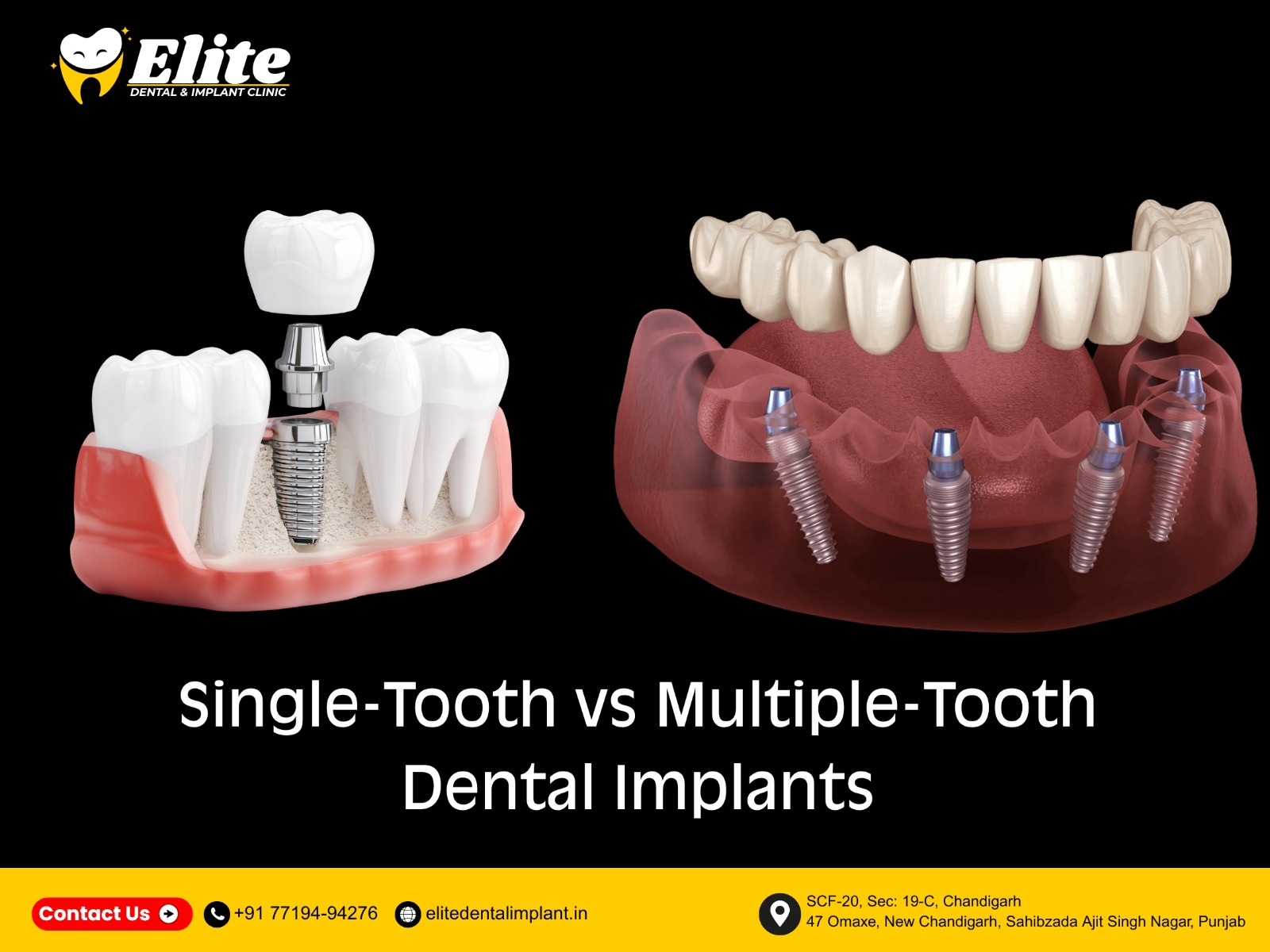
Single-Tooth vs. Multiple-Tooth Dental Implants
Introduction
Dental implants have become the standard for permanent tooth replacement — offering strength, natural feel, and preservation of jawbone health. But not all cases of missing teeth are the same. The number and distribution of missing teeth largely determine the ideal treatment plan. For a single missing tooth, a single-tooth dental implant (one implant supporting one crown) may be optimal. For several adjacent missing teeth, an implant-supported bridge or multiple-tooth dental implant solution (fewer implants supporting a multi-unit prosthesis) might be more practical.
Choosing correctly matters — because the right solution ensures durability, preserves bone, and restores function with the least compromise to remaining teeth. Choosing between these solutions is easier when you understand the different dental implant options available for replacing missing teeth.
Single-Tooth Dental Implant Procedure and Benefits
What is a Single-Tooth Dental Implant?
A single-tooth implant involves placing one implant into the jawbone at the site of a missing tooth and later attaching a single crown. This mimics a natural tooth both functionally and structurally. The implant serves as an artificial root, and once healed and integrated, the crown sits above the gum, replacing the lost tooth convincingly.
Key Benefits
• Independent Replacement — Because the implant is standalone, it does not rely on neighbouring teeth for support. In contrast to a traditional tooth-supported bridge, there is no need to file down or alter healthy adjacent teeth. This preserves the integrity and health of surrounding teeth.
• Bone Preservation — The implant simulates a natural tooth root, stimulating the jawbone and helping prevent bone resorption (the gradual shrinking of bone after a tooth loss). This supports long-term facial structure and oral health stability.
• Natural Appearance & Function — Because the crown emerges from the gum much like a natural tooth, the result is often more aesthetic. The chewing and biting feel tends to be very close to a natural tooth.
• Longevity & Durability — With good oral hygiene and care, a single-tooth implant has the potential to last many years — often decades — making it a long-term solution compared to conventional treatments.
Because of these benefits, for a solitary gap in your dentition where bone and gum health are good, a single-tooth implant is often considered the most ideal and physiologic replacement method.
Multiple Implants for Several Missing Teeth
What Is an Implant-Supported Bridge or Multi-Unit Solution?
When multiple adjacent teeth are missing, one option is an implant-supported bridge — where fewer implants (than missing teeth) are placed, and a multi-unit prosthesis (bridge) spans the gap. For example, two or more implants can support a three- or four-unit bridge.
Alternatively, for larger gaps or full-arch replacement, a series of adjacent individual implants can be placed — but often implant-supported bridges are chosen when cost, jawbone condition, or practicality make placing an implant for every missing tooth less feasible.
Why Use This Approach?
• Efficient for Large Gaps — For spaces too wide for a single crown, an implant-bridge can restore multiple teeth with fewer implants than number of teeth replaced, reducing surgical interventions.
• Budget & Bone-Friendly Option — Sometimes bone volume may not be sufficient at every missing tooth site. Using fewer implants reduces bone demands and can lower overall cost compared to multiple individual implants.
• Fixed, Permanent Replacement — Unlike removable dentures, an implant-supported bridge is fixed (non-removable by the patient) and offers stable chewing function and aesthetics comparable to natural teeth — often with improved comfort and speech compared to removable partial dentures.
Benefits and Considerations of Each Approach
| Factor / Criterion | Single-Tooth Implant (One-to-One Replacement) | Implant-Supported Bridge / Multiple-Tooth Solution |
| Total Cost | Generally higher per tooth (one implant + crown per missing tooth) | Lower total cost compared to same number of individual implants — because fewer implants are used |
| Number of Implants Required | One implant per missing tooth | Fewer implants than missing teeth (e.g., 2 implants supporting 3–4 teeth) |
| Maintenance / Cleaning | Each crown is separate — cleaning similar to natural teeth; easier flossing | Bridge connects multiple teeth — special cleaning (floss threaders, interdental brushes) may be needed under pontics; slightly more complex hygiene |
| Impact on Adjacent Teeth | None — adjacent healthy teeth untouched | Does not rely on natural teeth (unlike traditional bridges), so adjacent teeth remain unaffected, but the prosthesis spans multiple teeth together |
| Bone Stimulation / Jawbone Health | Each implant stimulates bone individually — good bone preservation | Bone stimulation only where implants are placed; areas under pontics may get less direct stimulus, potentially less bone maintenance than individual implants (though still better than removable dentures) |
Key considerations: Implant-supported bridges usually mean fewer surgeries, lower cost, and less complex planning than placing an implant per missing tooth. However, cleaning and maintenance require care, and bone preservation may be slightly less optimal where implants are not placed under each missing tooth.
Choosing Between Single and Multiple Implants
Decision Factors
1. Location of Missing Teeth (Front vs. Back):
o If you’re replacing a single front tooth, a single-tooth implant often yields the best aesthetics and gum contour.
o For multiple adjacent teeth — especially in areas not highly visible — an implant-supported bridge may provide a balanced solution of function, cost, and invasiveness.
2. Bone Density & Volume:
o If jawbone at each missing tooth site is adequate — single implants are ideal.
o If bone is insufficient at every spot, fewer implants (as in a bridge) may reduce surgical demand and still restore function.
3. Budget & Treatment Scope:
o Individual implants per missing tooth offer maximum long-term benefit, but cost can mount up if many teeth are missing.
o An implant-supported bridge offers a cost-effective but robust compromise — fewer implants, fewer surgeries, and acceptable long-term function.
4. Long-Term Oral Health & Maintenance:
o If you prioritize bone preservation, ease of hygiene, and independent tooth function, single-tooth implants offer greatest flexibility.
o If you accept additional hygiene care (floss threaders / special cleaning tools) and want fewer surgeries, a bridge may suit you.
Final Advice from an Implant Specialist’s Perspective
The overarching goal is to restore function, preserve bone, and maintain oral health with the least compromise. For many patients, an implant-supported bridge represents a practical balance — especially when multiple adjacent teeth are missing, or bone and budget constraints exist. For others, especially with isolated tooth loss and good bone health, single-tooth implants provide the most natural, long-lasting solution.
Ultimately, the decision should be made with a qualified implant specialist, based on clinical evaluation of bone volume, occlusion (bite), gum condition, and overall dental health. A well-planned implant strategy — whether single or multiple — can restore your smile, chewing ability, and jaw health for many decades.
Conclusion
Both single-tooth implants and multiple-tooth implant-supported bridges have strong roles in modern restorative dentistry.
• Single-tooth implants excel when only one tooth is missing — offering independent, bone-preserving, long-lasting results without touching adjacent teeth.
• Implant-supported bridges shine when there are several missing adjacent teeth — offering a practical, cost-effective, fixed solution with fewer implants and surgeries.
Your dental history, bone condition, aesthetic desires, and budget will guide which option is right for you. With proper planning, execution, and care, both approaches can deliver durable, functional, and healthy long-term teeth replacements.
If you’re evaluating replacement options for missing teeth, discussing with an experienced dental implant specialist will help you choose the most suitable solution — one that safeguards your oral health and gives you a confident, stable smile for years to come.
