
Endosteal vs. Subperiosteal Dental Implants
Introduction
Dental implants are widely regarded as the gold standard for replacing missing teeth — offering stability, natural appearance, and long-term oral health. But not all implants are identical. One of the major distinctions lies in how and where the implant is placed in relation to your jawbone: some go “in the bone”, others rest “on the bone”. These placement-based designs are part of the broader range of different types of dental implants, each suited to specific bone conditions and clinical needs.
What Are Endosteal Implants?
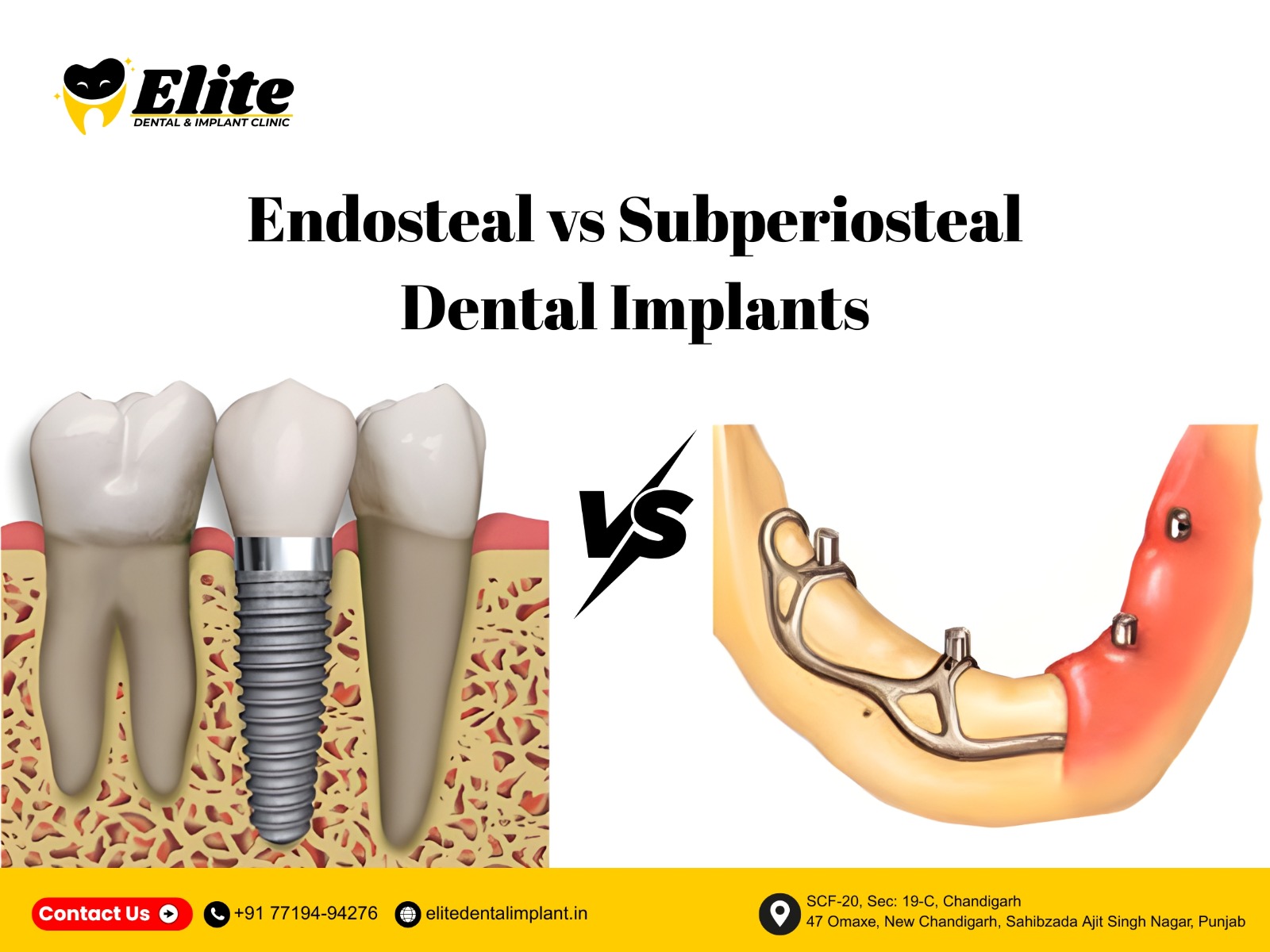
Endosteal implants are the standard and most commonly used type of dental implant.
• These implants are placed directly into the jawbone, becoming the artificial “root” for the replacement tooth.
• They come in different shapes, typically screws, cylinders, or blades, and are usually made of biocompatible materials like titanium (sometimes zirconia) that integrate well with bone.
• For an endosteal implant to be successful, you need adequate bone volume and density, so the implant can fuse securely with the bone via a process called osseointegration — where bone cells grow around and bond to the implant surface.
Because of this firm bone integration, endosteal implants are very stable and long-lasting — often the ideal choice for replacing one or more missing teeth.
What Are Subperiosteal Implants?
Subperiosteal implants follow a different approach. Instead of embedding into the bone, they are placed on top of the jawbone, but under the gum tissue.
• These implants use a custom metal framework that rests on the bone surface; posts attached to this framework protrude through the gums to support crowns, bridges or dentures.
• Subperiosteal implants are generally used less frequently today — but they remain a valuable solution for patients whose jawbone has resorbed (shrunk) or is too shallow to accommodate traditional implants, and who want to avoid bone grafting.
In short: subperiosteal implants are “on the bone,” under the gum — offering an alternative when bone structure is insufficient for in-bone implants.
Key Differences Between Endosteal and Subperiosteal Implants
| Criteria | Endosteal Implants | Subperiosteal Implants |
| Placement Location | Directly in the bone (jawbone) | On the bone (resting on jawbone), under gums |
| Procedure | Surgical drilling into bone, implant insertion, healing for osseointegration | Gums lifted, a metal framework placed over bone, gums replaced — no deep bone drilling |
| Healing Time / Process | Requires time for bone to fuse with implant (osseointegration) — often months before final restoration | Gums heal over the framework; since implant rests on bone, process may be shorter and grafting often not required |
| Success Rate & Stability | High success (> 95%) when bone quality is adequate — very stable long-term support | Moderate stability; effectiveness depends on fit and bone anatomy. Historically lower success if not well maintained |
| Suitability (Bone Requirement) | Needs good bone density and volume (or bone grafting first) | Useful when bone is too thin or resorbed, and bone grafting is not feasible or desired |
| Surgical Invasiveness | More invasive (bone drilling, multiple surgical stages) | Less invasive in terms of bone manipulation; no deep bone drilling required |
When Each Type Is Recommended
Endosteal Implants
• Best for patients with healthy jawbone density and volume.
• Suitable for replacing single or multiple missing teeth, or even supporting bridges/dentures.
• Also recommended if you’re open to bone grafting (when bone volume is slightly insufficient) and want a long-term, highly stable solution.
Subperiosteal Implants
• Best for patients with severe bone resorption, where jawbone is too thin or worn down for traditional implants.
• Ideal if you want to avoid bone grafting or additional bone surgery.
• Useful when you prefer a less invasive process but still wish for fixed teeth (crowns, bridges, dentures).
Choosing the Right Implant Type for You
Deciding between endosteal and subperiosteal implants is not something you should decide alone — it requires a careful assessment by an implant specialist.
• Your dentist will use diagnostic tools like X-rays or 3D CT / CBCT scans to evaluate your jaw’s bone width, height, and density. This determines whether you have enough bone for endosteal implants or if subperiosteal is more appropriate.
• Your overall health, oral hygiene, bite forces, and expectations also play a role.
• Based on these factors, a personalised treatment plan can be created: sometimes options like bone grafting or hybrid techniques may be suggested.
If you live in or around Chandigarh — or are an NRI looking to travel to India for treatment — you might consider consulting with an experienced clinic like Elite Dental and Implant Clinic, where such implant options are evaluated carefully for every patient.
Conclusion
Understanding the difference between endosteal (in the bone) and subperiosteal (on the bone) dental implants is important before you commit to tooth replacement.
• Endosteal implants are the standard, highly stable option when bone volume allows.
• Subperiosteal implants serve as a valuable alternative when the jawbone is too thin or resorbed — especially if you want to avoid bone grafting.
The right choice depends on your bone anatomy, oral health, and personal needs. A thorough clinical evaluation — including bone imaging — by a qualified implant dentist is key.
If you’re considering implants in or around Chandigarh (or travelling from abroad), a trusted expert like Dr. Gourav Ahuja can guide you toward the most suitable option, tailored to your condition.
With a proper evaluation and good oral care, both types of implants can help restore your smile, chewing function, and confidence.
